The Liver and Hormones: Why Supporting Your Liver Is Essential for Women's Health
Your liver processes every hormone in your body. When it's overburdened, excess estrogen builds up, contributing to PMS, fibroids, weight gain, and fatigue. Here's how to support your liver naturally.
When women come to me struggling with stubborn weight gain, worsening PMS, heavy periods, breast tenderness, mood swings, or that persistent sense of hormonal chaos — one of the first places I look is the liver. Not because the liver is the only factor, but because it is so often overlooked, and because its role in hormonal health is so foundational that no amount of hormone-balancing supplements or dietary changes will work optimally if the liver is overburdened.
Today I want to give you a clear picture of what the liver does for your hormonal health, what compromises it, and the most effective natural ways to support it.
The Liver as Hormonal Housekeeper
Your liver performs over 500 functions in the body, but for the purposes of hormonal health, its role as the body's primary detoxification organ is paramount. Every hormone that circulates in your bloodstream — estrogen, progesterone, testosterone, cortisol, thyroid hormones — must eventually be processed and cleared by the liver.
Estrogen metabolism is particularly relevant for women. After estrogen has done its job in the body, it travels to the liver, where it undergoes a two-phase detoxification process. In Phase 1, enzymes break estrogen down into intermediate metabolites. In Phase 2, these metabolites are conjugated (attached to other molecules) to make them water-soluble and ready for excretion via bile into the digestive tract, and ultimately out of the body in stool and urine.
When this process works well, used estrogen is efficiently cleared and the body maintains healthy estrogen balance. When the liver is overburdened — by alcohol, processed foods, environmental toxins, medications, or chronic stress — estrogen clearance slows. Unconjugated estrogen metabolites can be reabsorbed from the gut back into circulation (particularly if the gut microbiome is disrupted), and estrogen levels build up over time. This is one of the primary drivers of what practitioners call "estrogen dominance."
Signs Your Liver May Need Support
Many of the symptoms women attribute to "hormonal imbalance" are actually downstream effects of impaired liver function. Watch for: heavy, painful, or clotty periods; worsening PMS symptoms (especially mood changes, breast tenderness, and bloating in the week before your period); difficulty losing weight despite a healthy diet; skin breakouts, particularly along the jawline and chin; fatigue that is worse in the morning; sensitivity to alcohol (feeling worse after even small amounts); nausea or discomfort after fatty meals; and a general sense of sluggishness or "toxic" feeling.
None of these symptoms alone is diagnostic of liver dysfunction — they can have many causes. But when several of them cluster together, supporting liver function is a wise and often transformative place to start.
What Burdens the Liver
The liver is remarkably resilient, but modern life gives it a great deal to process. Alcohol is one of the most significant liver stressors — even moderate regular consumption impairs Phase 2 detoxification and estrogen clearance. Processed foods, particularly those containing refined sugars, industrial seed oils, and artificial additives, promote fatty liver and impair detoxification capacity.
Environmental toxins — pesticides, plasticizers (from plastics), synthetic fragrances, heavy metals, and household chemicals — all require liver processing. Medications, including over-the-counter pain relievers like acetaminophen, add to the detoxification burden. Chronic stress elevates cortisol, which impairs liver function over time. And a disrupted gut microbiome — specifically an overgrowth of bacteria that produce the enzyme beta-glucuronidase — can cause deconjugation of estrogen in the gut, allowing it to be reabsorbed rather than excreted.
Nourishing Your Liver Through Food
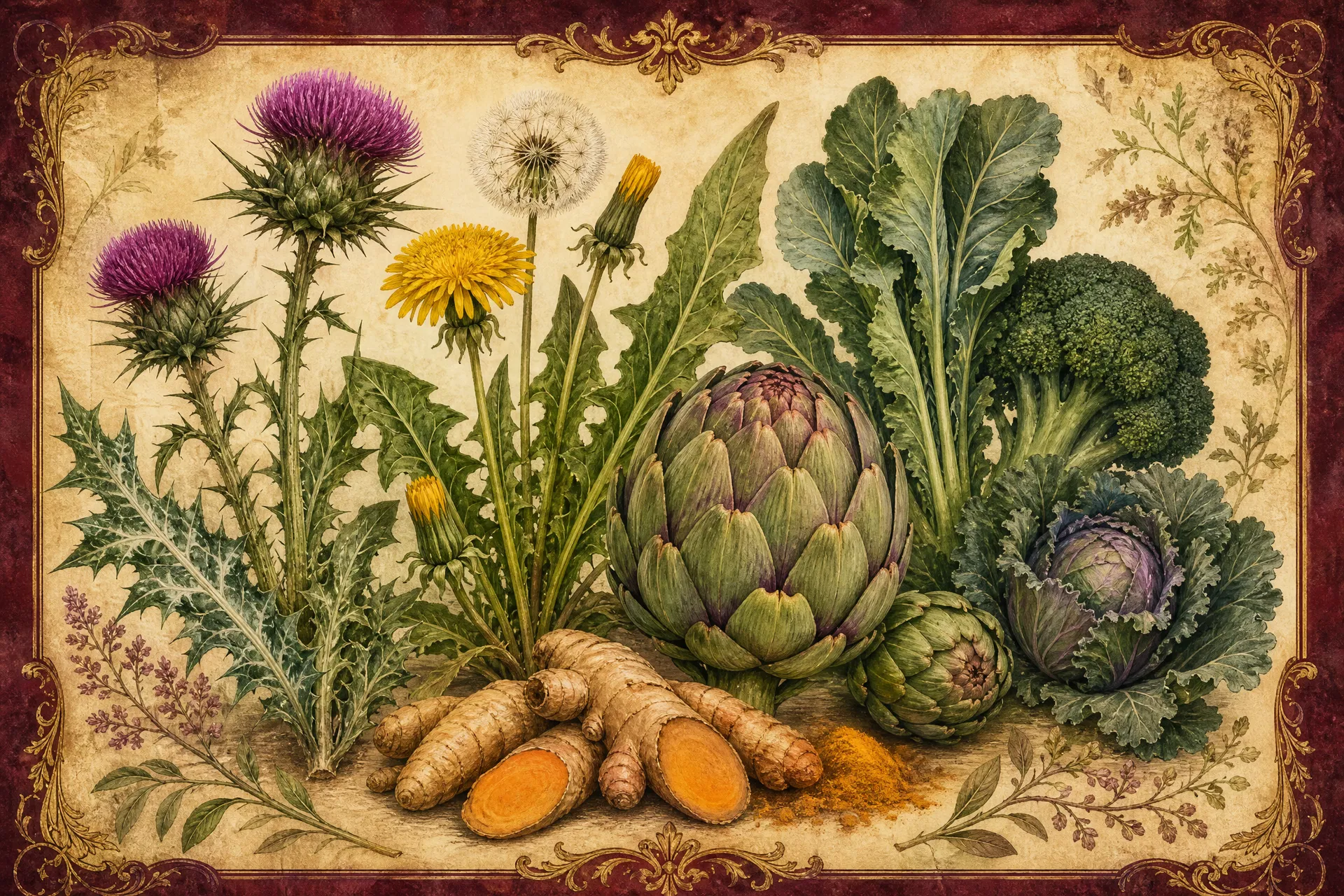
The liver requires specific nutrients to carry out its detoxification work effectively. Cruciferous vegetables — broccoli, cauliflower, Brussels sprouts, kale, cabbage, and arugula — are among the most powerful liver-supportive foods available. They contain compounds called glucosinolates that upregulate Phase 2 detoxification enzymes and support healthy estrogen metabolism. Aim for at least one serving of cruciferous vegetables daily.
Bitter greens — dandelion greens, arugula, radicchio, endive — stimulate bile production and flow, which is essential for hormone excretion. Beets contain betaine, which supports methylation (a key Phase 2 detoxification pathway). Garlic and onions provide sulfur compounds that support glutathione production — the liver's master antioxidant. Lemon juice in warm water first thing in the morning stimulates bile flow and supports gentle liver cleansing.
Adequate protein is essential for Phase 2 detoxification — the amino acids glycine, taurine, glutamine, and cysteine are directly used in conjugation reactions. Women who are chronically low in protein often have impaired detoxification capacity.
Herbal Liver Support
Several herbs have well-documented liver-protective and liver-supportive properties. Milk thistle (silymarin) is the most extensively researched — it protects liver cells from damage, stimulates liver cell regeneration, and supports both phases of detoxification. Dandelion root supports bile production and flow. Artichoke leaf extract enhances bile secretion and has been shown to reduce liver enzyme levels. Schisandra berry is an adaptogen with specific liver-protective properties. Turmeric supports Phase 2 detoxification and reduces liver inflammation.
The Milk Thistle Liver Detox Tea in our Wellness Library is a gentle, delicious way to incorporate several of these herbs into your daily routine.
Supporting the Estrogen-Gut Connection
Because the gut plays such a critical role in estrogen excretion, gut health is inseparable from liver health in the context of hormonal balance. Adequate dietary fiber — particularly from vegetables, legumes, and whole grains — binds to estrogen metabolites in the gut and carries them out of the body in stool. Constipation is therefore a significant risk factor for estrogen recirculation: if stool sits in the colon for too long, estrogen metabolites have more time to be reabsorbed.
A diverse, fiber-rich diet that supports a healthy gut microbiome is one of the most powerful things you can do for both liver and hormonal health simultaneously.
A Gentle, Sustainable Approach
Liver support doesn't require a dramatic "detox" or a restrictive cleanse. In fact, extreme detox protocols can sometimes stress the liver further. What works is consistent, gentle, daily support: cruciferous vegetables, adequate fiber, quality protein, herbal teas, reduced alcohol and processed food, and minimizing exposure to environmental toxins where possible.
Think of it as creating the conditions for your liver to do its job beautifully — not forcing a process, but removing obstacles and providing nourishment.
Your hormones will thank you.
With love, Donna
#TreeOfLifeWellnessCoach #DonnaMurray #LiverHealth #HormonalBalance #EstrogenDominance #WomensHealth #NaturalDetox #WellnessCoach #GraceHopeHealing
Ready to walk this out with support?
Book a free discovery call and let's talk about what your body has been trying to tell you.
Book a discovery call