Seed Cycling: A Natural Way to Support Hormonal Balance Through Your Cycle
Seed cycling is a gentle, food-based practice that uses specific seeds during each phase of your menstrual cycle to support estrogen and progesterone balance. Here's everything you need to know to get started.
When I first heard about seed cycling, I'll be honest — I was skeptical. It sounded almost too simple. Eat certain seeds during the first half of your cycle, switch to different seeds during the second half, and support your hormonal balance? Could it really be that straightforward?
After researching the underlying mechanisms, working with dozens of women who've tried it, and experiencing the practice myself, I've become a genuine advocate. Not because it's a miracle cure — it isn't — but because it's a gentle, accessible, food-based practice that works with your body's natural hormonal rhythms, and for many women, it makes a meaningful difference.
Understanding Your Hormonal Cycle
To understand seed cycling, you first need a basic picture of the hormonal dance that governs the menstrual cycle. The cycle is divided into two main phases:
The Follicular Phase (Days 1–14, approximately) begins on the first day of menstruation and ends at ovulation. During this phase, estrogen is the dominant hormone. It rises gradually, stimulating the growth of follicles in the ovaries and thickening the uterine lining. Estrogen also supports mood, energy, libido, and cognitive sharpness — many women feel their best during this phase.
The Luteal Phase (Days 15–28, approximately) begins after ovulation and ends when menstruation begins. After ovulation, the ruptured follicle becomes the corpus luteum, which produces progesterone. Progesterone is the calming, stabilizing hormone — it supports sleep, reduces anxiety, and prepares the uterine lining for potential implantation. If estrogen and progesterone are well-balanced during this phase, the second half of the cycle feels relatively smooth. If estrogen is too high relative to progesterone (a common pattern called estrogen dominance), this is when PMS symptoms tend to appear.
How Seed Cycling Works
Seed cycling uses the lignans, essential fatty acids, and minerals in specific seeds to gently support the hormonal needs of each phase.
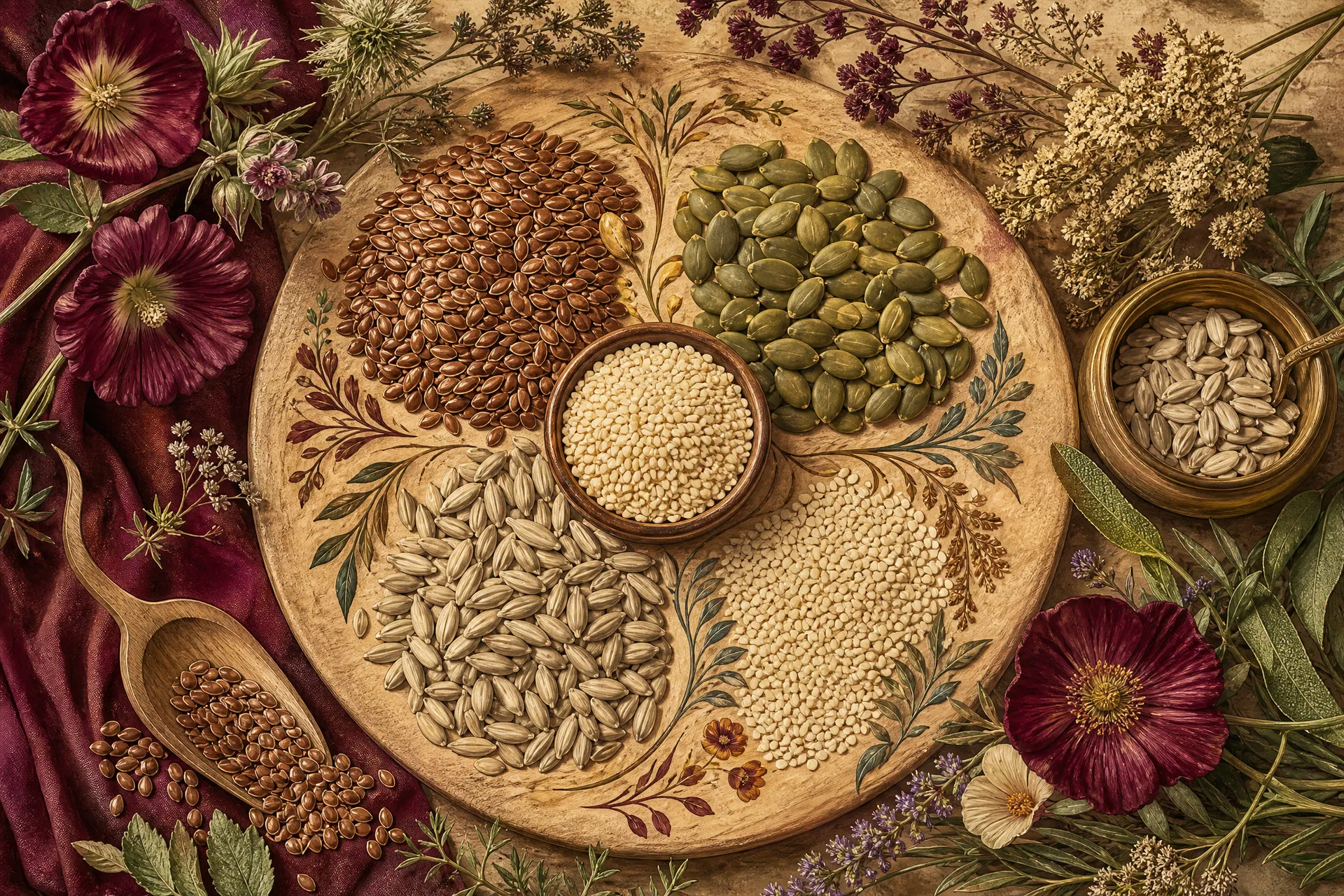
Follicular Phase Seeds (Days 1–14): Flaxseeds and Pumpkin Seeds
Flaxseeds are rich in lignans — plant compounds that bind to estrogen receptors and help modulate estrogen activity. They act as adaptogenic modulators: if estrogen is too high, lignans can help reduce its effects; if it's too low, they provide mild estrogenic support. Flaxseeds are also rich in omega-3 fatty acids, which support healthy prostaglandin production and reduce menstrual cramping.
Pumpkin seeds are one of the richest plant sources of zinc, which supports the production of progesterone in preparation for the luteal phase. They also provide iron (helpful during menstruation), magnesium, and omega-3 fatty acids.
Luteal Phase Seeds (Days 15–28): Sesame Seeds and Sunflower Seeds
Sesame seeds are rich in lignans (particularly sesamin and sesamolin) and zinc, which support progesterone production and help the body metabolize excess estrogen. They also provide calcium and magnesium, both of which are depleted during the luteal phase and associated with PMS symptoms when low.
Sunflower seeds are exceptionally high in vitamin E, a fat-soluble antioxidant that supports progesterone production and has been shown in studies to reduce PMS symptoms. They also provide selenium, which supports thyroid function and liver detoxification of hormones.
How to Practice Seed Cycling
The practice is beautifully simple:
Days 1–14: Consume 1 tablespoon each of freshly ground flaxseeds and raw pumpkin seeds daily.
Days 15–28: Consume 1 tablespoon each of raw sesame seeds (or tahini) and raw sunflower seeds daily.
A few important notes: Flaxseeds should be freshly ground (not pre-ground) to maximize lignan availability — whole flaxseeds pass through the digestive system largely undigested. A small coffee grinder works perfectly. The other seeds can be eaten whole or ground. Raw is preferred over roasted, as heat can damage the delicate fatty acids.
The easiest way to incorporate seed cycling is to add your daily seeds to smoothies, yogurt, oatmeal, salads, or homemade energy balls. Many women find it helpful to prepare a week's worth of ground flaxseed at a time and store it in the freezer.
What to Expect
Seed cycling is a gentle, cumulative practice. Most women don't notice dramatic changes in the first month. By the second and third month, many begin to notice improvements in PMS symptoms — less bloating, reduced breast tenderness, more stable mood in the week before their period, and lighter, less painful periods.
For women with irregular cycles, seed cycling can sometimes help regulate the cycle over time, though this typically takes 3–6 months of consistent practice. For women in perimenopause, seed cycling can help smooth some of the hormonal fluctuations of this transition.
If you don't have a regular cycle (due to perimenopause, PCOS, or other reasons), you can sync seed cycling to the moon cycle instead: follicular seeds from new moon to full moon, luteal seeds from full moon to new moon.
Who Might Benefit Most
Seed cycling is particularly worth trying if you experience PMS symptoms (mood changes, bloating, breast tenderness, cramping), irregular cycles, symptoms of estrogen dominance (heavy periods, fibroids, endometriosis, fibrocystic breasts), or if you're in perimenopause and looking for gentle hormonal support.
It's generally considered safe for most women, including those on hormonal birth control (though the effects may be less noticeable). If you have a hormone-sensitive condition such as estrogen receptor-positive breast cancer, please consult your healthcare provider before beginning.
A Note on Whole-Body Hormonal Support
Seed cycling is most effective as part of a broader approach to hormonal health that includes blood sugar stability, adequate sleep, stress management, liver support (the liver is responsible for metabolizing and clearing excess hormones), and reducing exposure to environmental estrogens (xenoestrogens) from plastics, pesticides, and synthetic fragrances.
Think of seed cycling as one beautiful thread in a larger tapestry of care for your hormonal health — not a standalone solution, but a meaningful and nourishing addition to your wellness practice.
With love, Donna
#TreeOfLifeWellnessCoach #DonnaMurray #SeedCycling #HormonalBalance #WomensHealth #NaturalHormoneSupport #HolisticWellness #WellnessCoach #GraceHopeHealing
Ready to walk this out with support?
Book a free discovery call and let's talk about what your body has been trying to tell you.
Book a discovery call